After the election — what changes for the economy: how a changed legislative balance reaches oil, financing, investment and households over six months, alongside the Sunday signal board, the 48 / 11 / 41 outlook for the next two to four weeks, the six-month Market Read through about May 2027, and the catalyst calendar.
The Sunday feature traces three clocks — markets in minutes, legislation in months, operations over years — through the election week’s oil reversal, the AI financing question and the lessons of 1994, 2011 and 2018–19, and ranks three qualitative paths through next spring. The standard component covers the week’s developments — October payrolls at +165,000, hot ISM prices, Thursday’s selloff, Brent’s 13% weekly fall and the port deadline’s move to November 20 — with the outlook retained at Saturday’s 48 / 11 / 41.
The report window follows the Listening Edition—moving from the spoken thesis to supporting numbers, regions, scenarios and the watch list.
Choose an edition and voice.
Listening Edition audioSunday, November 8, 2026 · 24 min 52 sec
Listening Edition
The week in review — and the outlook from here
Sunday Edition · November 8, 2026
Base 48% — expansion continues under pressure
Bull 11% — relief becomes broad and durable
Bear 41% — disruption spreads into activity
TakeawayThe outlook for the next two to four weeks: Base 48%, Bull 11%, Bear 41%.
Listening Edition
Hiring holds; households and markets warn
October payrolls increased by 165,000; unemployment was 4.1%
Household resilience is uneven: September real disposable income fell while revolving credit balances grew at a 14.5% annualized pace
Friday’s rebound left the S&P 500 down about 2.7% for the week and the Nasdaq down about 3.4%
TakeawayActivity continues — but the route from growth to financial comfort is less dependable.
Listening Edition
The signal board
Financial conditions: FRAGILE — financing remains available but expensive; Oracle’s recently priced bonds carried coupons of 7.00% to 8.65%
Physical economy: RELIEF WITH RISK — January Brent ended Friday at $98.32; maritime risk persists; port deadline extended to November 20
Growth and investment: CONTINUING — employment and surveys support activity; funding and cash conversion remain essential
Households and breadth: UNEVEN — weak real-income cushion and rising revolving balances; regional conditions differ
TakeawayActivity continues while finance, supply and households each carry a warning.
outlook
The next two to four weeks
Narrated edition
TakeawayBase is the largest individual possibility at 48% — a plurality, not a majority. The outlook is held from Saturday; Tuesday’s inflation report is the next major test.
Listening Edition
The six month perspective
The stance remains selective rather than broadly bearish, with flexibility emphasized
The core question: whether investment produces enough useful capacity and cash to justify its cost
A more constructive outlook requires several signals to improve together: underlying inflation, physical supply, workable funding and broader participation
For portfolios: review concentration and near-term cash needs while retaining a diversified plan
TakeawayParticipate selectively while preserving the ability to respond to evidence.
Listening Edition
After the election — what changes for the economy
Three clocks: markets react within minutes; legislation and administrative decisions take months; operations take longer
Election week exposed the gaps between those clocks
The incoming Congress begins its term in January — much of the next six months will reflect earlier decisions
Working view: selective progress is more likely than either rapid transformation or broad breakdown
TakeawayJudge implemented decisions and operating results — and oil shows the first clock at work.
energy
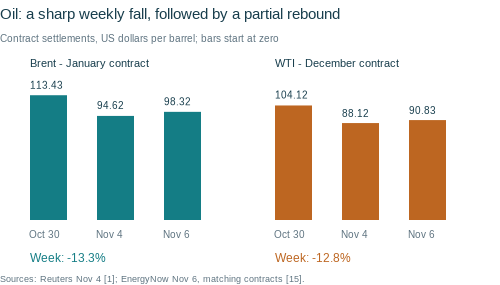
Oil: a sharp weekly fall, then a partial rebound
Brent and WTI settlements — October 30 to November 6
On Wednesday, Brent settled at $94.62; by Friday it had recovered to $98.32 — still substantially below the previous Friday
The weekly comparison chart shows both facts: a sharp decline followed by a partial rebound, with no spliced delivery months
Oil can also fall for a less encouraging reason: people and businesses consuming less
TakeawayA lower quotation is relief only if the supply behind it is dependable.
energy
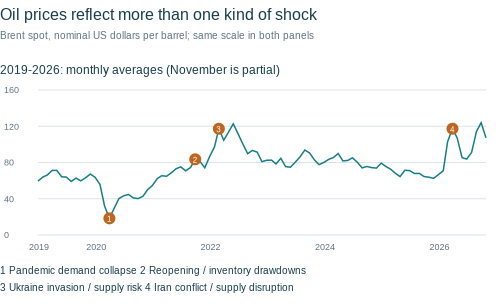
The longer oil story — the monthly view
Brent spot price, monthly averages — 2019 to November 2026 (partial month)
Our longer oil chart begins in 2019, before the pandemic and Russia’s full-scale invasion of Ukraine
In 2020, travel and fuel use collapsed while production could not adjust immediately — low prices accompanied serious economic damage
Reopening reversed the pressure: demand recovered while production and inventories struggled to keep pace
TakeawayThe same price move can carry opposite meanings — the cause matters more than the quote.
energy
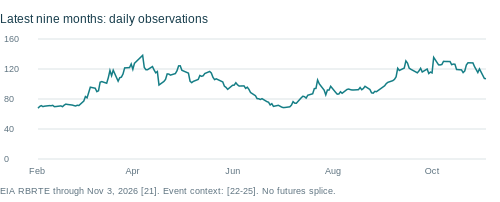
The longer oil story — the recent nine months
Brent spot price, daily — latest nine months
The retrieved Brent spot series reached about $138 on April 7, about $69 on July 2, and $107 on November 3
Those are spot observations; Friday’s $98.32 figure is a futures settlement, so they are not one continuous price series
The Iran conflict and supply disruption help explain those swings; the question is whether diplomatic expectations become reliable deliveries
TakeawayWatch shipments and deliveries, not only settlements.
electronics
Investment demand and the price of financing it
The technology selloff does not establish that demand for computing has disappeared
A project needs customers, physical inputs and enough money to reach completion — power, chips and construction all bind
The signals already visible suggest selectivity rather than a uniform collapse
Differences between bookings, shipments and recognized revenue remind us that an order is not yet cash in the bank
TakeawayFollow funded projects through to completion, not announcements.
Listening Edition
A wider gap between funded and unfunded projects
Our expectation over six months: a wider gap between projects with committed customers and dependable funding, and those without
That is a forecast, not a claim that widespread cancellations have already occurred
Cheaper oil helps some operating costs, but cannot solve every power, funding or customer problem
TakeawayThe path of the economy depends on which projects actually get financed.
Listening Edition
What legislation can and cannot change
Congress influences taxes, spending, oversight and the conditions attached to federal programs
Trade illustrates the distinction: Congress has constitutional authority over tariffs and foreign commerce
For a Canadian supplier or Mexican manufacturer, a durable rule can matter more than a favorable speech
Evaluate implemented decisions and operating results; political disagreement alone does not settle the question
TakeawayLegislation moves on the slow clock — its effects arrive through decisions firms and households actually make.
review
What history helps explain
After the 1994 election, divided institutions engaged in budget disputes that produced government shutdowns
The 2011 debt-limit confrontation illustrates another channel: the GAO estimated that delays raised Treasury borrowing costs by about $1.3 billion in that fiscal year
During the partial shutdown that ended in January 2019, much of the delayed activity was eventually recovered, though the CBO estimated roughly $3 billion would not be recovered
TakeawayHistory identifies mechanisms — it does not tell us what markets must return after a midterm.
review
Cooperation belongs in the history too
Divided government also produced the 1986 tax overhaul, and after the 2018 election a Democratic-controlled House approved legislation implementing the USMCA agreement
Selecting only episodes of confrontation would give a misleading account
Inflation, interest rates, technology and energy shape outcomes alongside politics
TakeawayExpect adjustment before transformation.
outlook
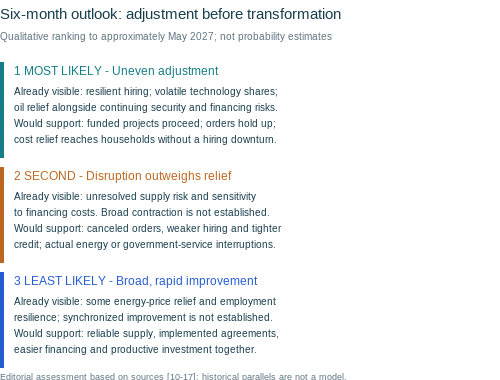
Three paths through next spring
Three qualitative paths through May 2027 — ranked, not probabilities
Most likely: uneven adjustment with selective relief — hiring and investment continue, agreements emerge in some areas, and energy is less expensive than at recent peaks without becoming dependably cheap
Second: disruption outweighs relief — energy interruptions, expensive finance or operational funding disputes begin affecting orders and employment; canceled projects, interrupted deliveries and worsening repayment would make it more likely
Least likely as a complete package: broad, rapid improvement — dependable energy supply, policy agreements that reduce uncertainty, easier finance and resilient employment must align within six months
TakeawayA qualitative ranking of mechanisms and evidence — not another set of probabilities.
outlook
Why the ranking falls this way
A delayed project can reduce a supplier’s receipts, which can then reduce hiring and household spending — the links can reinforce each other
Disruption ranks second because the current evidence does not establish a broad contraction — but its mechanisms are concrete: interrupted supply, funding disputes, delayed agreements
Broad improvement ranks third because it requires several favorable developments to align within six months
The paths chart is a comparison of mechanisms and evidence, not a measured probability model
TakeawayThe central judgment is modest: expect adjustment before transformation.
Listening Edition
Portfolio balance
The written report includes household examples and questions to review with your financial professional.
TakeawayDetailed portfolio illustration remains in the written report.
close
The closing watch
The economy has not stopped growing because markets became unsettled — but growth alone does not remove financing pressure
In the coming week, watch inflation detail, actual deliveries and the terms on which investment is funded
Selective progress is our leading expectation; flexibility remains valuable because the outcome is not settled
For the full detail behind today's summary, read the written edition — and on the site you'll also find the reading list, the Market Read, and our editorial promise.
TakeawayThis has been the Market Intelligence Listening Edition for November 8, 2026.
For the complete analysis, charts, source citations and curated reading list, visit the Market Intelligence website. The downloadable written report explains the evidence and includes links to the original sources. You can also explore earlier editions to see how the outlook has changed.