From outlook to portfolio: investing through an uneven economy — who pays for the AI build-out, what is actually inside the funds households own, and what income investments promise, alongside the Sunday signal board, the 43 / 7 / 50 outlook for the next two to four weeks, the six-month Market Read through about May 2027, and the catalyst calendar.
The Sunday feature starts with the receipts — CoreWeave’s $846 million of quarterly net interest expense against $3.661 billion of revenue and a $132.5 billion backlog, and TSMC’s company-wide October revenue up nearly 60% — then looks inside a fund (overlap, fees and target dates), compares SGOV’s 3.86% yield and 0.11-year duration with AGG’s 5.03% and 5.70 years, and works through two households, including why the order of returns changes what is left after withdrawals: $77,500 versus $82,000 on identical returns. The standard component covers the week’s developments — October consumer prices up 0.4%, producer prices up 6.5% over the year, home sales at a 3.75 million pace and claims at 200,000 — with the outlook at 43 / 7 / 50, one point from Bear to Base against Saturday. Educational examples, not personalized recommendations.
The report window follows the Listening Edition—moving from the spoken thesis to supporting numbers, regions, scenarios and the watch list.
Choose an edition and voice.
Listening Edition audioSunday, November 15, 2026 · 25 min 30 sec
Listening Edition
From outlook to portfolio
Sunday Edition · November 15, 2026
Outlook, next two to four weeks: Base 43% · Bull 7% · Bear 50%
The week in review and the signal board, then the six-month Market Read
Special feature: from outlook to portfolio — AI financing, the funds you own, and two households
TakeawayThe economy can grow while some investments disappoint — today connects the outlook to the choices it should, and should not, change.
Listening Edition
A recovery, not an all-clear
The major indexes recovered over the week, but technology remained vulnerable on Friday — the semiconductor index fell 3.4% that day
October consumer prices rose 0.4%, after 0.6% in September — slower, but still rising
Producer prices were up 6.5% from a year earlier, with underlying monthly pressure still firm
TakeawayCosts eventually meet a decision: raise prices, accept less profit, delay investment or reduce activity.
Listening Edition
Housing restrains; labor supports
Existing-home sales fell 5.5% in October to an annual pace of 3.75 million — yet the median price was still slightly higher than a year earlier
Initial unemployment claims were 200,000 in the week ended November 7 — no broad firing wave
Employment supports income while housing shows the restraint from expensive borrowing
TakeawayFewer transactions weaken commissions, furnishing purchases and related activity before house prices fall broadly.
Listening Edition
Policy, energy and execution
Boston Fed President Susan Collins favored a gradual path of rate increases on Saturday — an argument about pace, not a promise of cheap money
The IEA sees improving oil balances, but inventories at sea are not fuel where customers need it; the Iran conflict still creates transport and supply risks
Nvidia’s board accepted Jensen Huang’s resignation and appointed Colette Kress interim chief executive — the business question is continuity, and Tuesday’s results will offer evidence
TakeawayThe standing test: is a headline changing actual costs, production and income? A meeting is not an implemented trade agreement.
Listening Edition
The signal board
Financial conditions: CAUTION — ten-year Treasury near 5.15%; equities recovered over the week, chips weakened Friday
Growth and capital spending: STRONG DEMAND WITH FUNDING RISK — TSMC sales and Eaton cash generation contrast with CoreWeave’s interest burden
Labor and households: RESILIENT EMPLOYMENT — initial claims 200,000; October retail sales not yet released
TakeawayExpansion is still functioning, but it has less room for disappointment — that is the reasoning behind the probabilities.
scenarios
The next two to four weeks
43%BaseExpansion continues under cost pressure — employment and investment can keep activity moving despite higher costs
7%BullRelief becomes broad and durable — inflation pressure eases, financing becomes manageable and demand stays resilient
50%BearOperating pressure spreads into retrenchment — costly financing and weaker rate-sensitive activity spread before relief arrives
TakeawayOne point moved from Bear to Base versus Saturday, on the gradualist policy argument. Bear at 50% is not a 50% probability of recession, and the probabilities are not portfolio percentages.
Listening Edition
The six-month Market Read
Over six months, the stance remains selective rather than broadly bearish, with flexibility emphasized
Uneven expansion is still the leading path, but the margin over the adverse path has narrowed
Companies have time to adjust schedules, secure financing and bring new capacity into service — adaptation gets a larger role than in an immediate risk window
The favorable path needs underlying inflation to ease, deliveries to become more dependable, financing to remain workable and growth to broaden
TakeawayThe longer view can be less negative than the next month — without being comfortable.
Listening Edition
Who pays for the AI build-out
Educational examples, not personalized recommendations — discuss investment, withdrawal and tax decisions with a qualified financial adviser
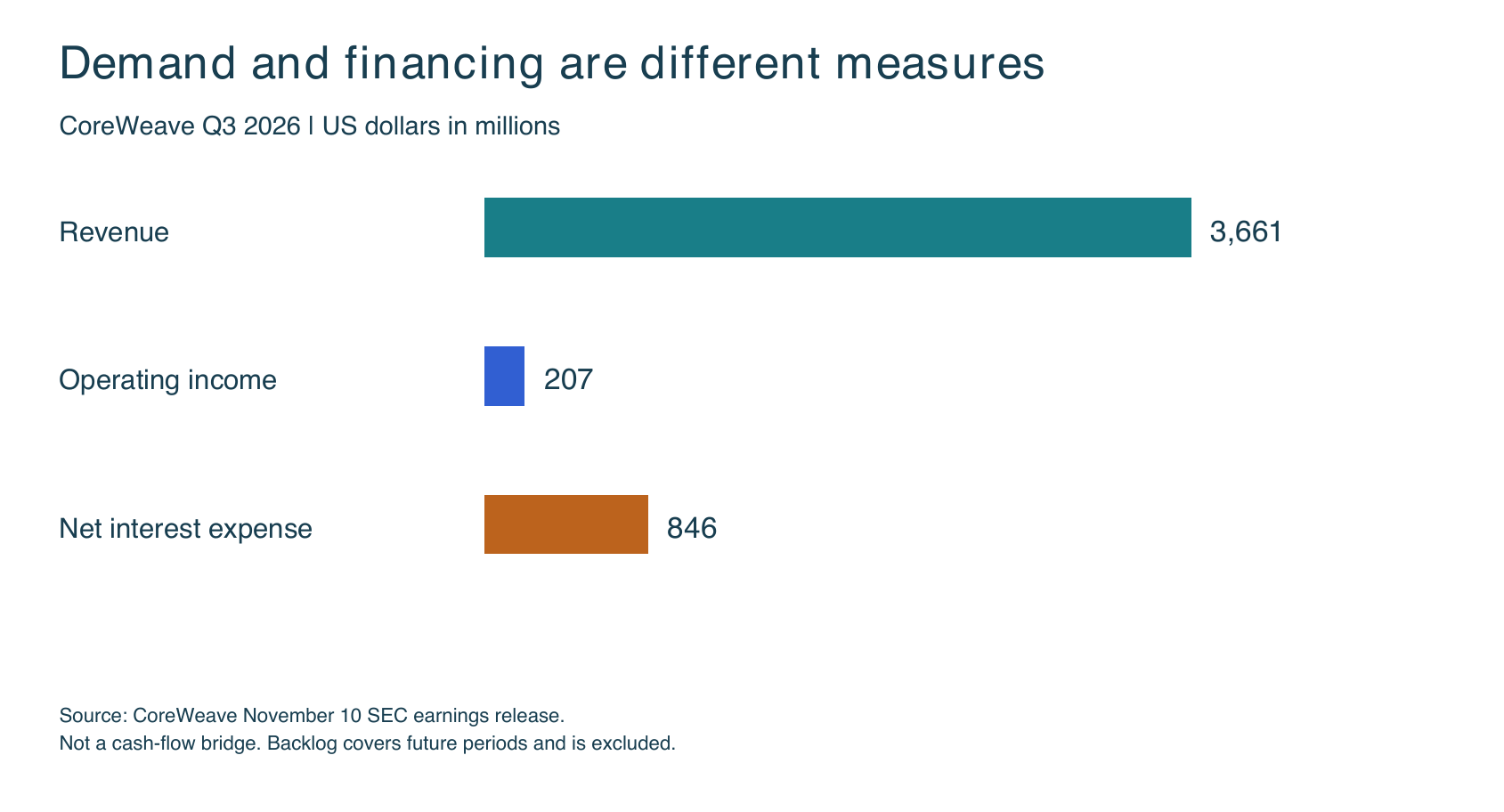
CoreWeave: quarterly revenue $3.661 billion; net interest expense $846 million; backlog $132.5 billion — future business subject to delivery, not cash available today
TSMC: October revenue up nearly 60% from a year earlier — company-wide sales, not AI-only profits
TakeawayDemand and financing deserve separate attention: one business may be paid for supplying technology while another carries the cost of the infrastructure.
Listening Edition
The receipts: revenue, income and interest
CoreWeave Q3 2026 — revenue, operating income and net interest expense
Interest is substantially greater than operating income — a financing burden to examine, not proof of insolvency
Backlog is deliberately outside this comparison: future contracted business is not money collected this quarter
Net interest expense is not necessarily the cash interest paid in the quarter
TakeawayThe technology can succeed while returns vary enormously among the companies involved.
Listening Edition
Follow the financing chain
Investors and lenders provide capital; suppliers deliver hardware; operators need power and paying customers — at every stage, the timing of money in and out matters
Eaton reported 19% organic sales growth in the third quarter and more than $1 billion of operating cash flow — operating evidence, not proof the stock is a bargain
The useful question: what has to go right to justify the price I would pay?
TakeawayRisk migrates along the chain — a supplier may be paid even when the operator later struggles; shareholders absorb what lender collateral does not.
review
History, households and the stability report
The telecom investment boom around the turn of the century was followed by a severe reversal — a comparison, not a prediction: can commitments grow faster than the profitable use of capacity?
The household sits at the end of the chain: an investment boom supports employment while adding to cost pressures
The Federal Reserve’s stability report: more than $680 billion of advanced-computing debt issuance through October — issuance, not total debt outstanding
TakeawayLarge customers have substantial cash generation — an important difference from weaker historical borrowers. Growing commitments still need to earn their keep.
Listening Edition
Look inside the fund
A mutual fund pools investors’ money; an ordinary mutual fund trades at its next calculated asset value, an ETF during the day — neither label tells you whether it is diversified enough
A broad US equity fund, an S and P five hundred fund and a technology fund can own many of the same companies — examples to research include VTI, Fidelity’s FXAIX, and VGT
Worked example: 60% of a portfolio in one fund holding a company at 6%, plus 20% in another holding it at 15%, puts 6.6% of the entire portfolio into that one company
TakeawayStart with the objective and the holdings, then sector weights, countries, fees and the role the fund plays alongside the rest of the household’s assets.
Listening Edition
Fees, target dates and distributions
Fees: a half-percentage-point difference is about $500 a year on a steady $100,000 balance, before compounding
A target-date fund’s date is not a guarantee — funds with the same retirement year may take different risks
A tactical idea needs a reason for entry, a limit on the amount at risk and a condition for exiting; retirement capital needs a durable allocation
A fund distribution is not free money: the payout reduces the fund’s asset value, other things equal
TakeawayLower fees cannot rescue an unsuitable strategy, but avoidable costs reduce the return you keep.
Listening Edition
What income investments actually promise
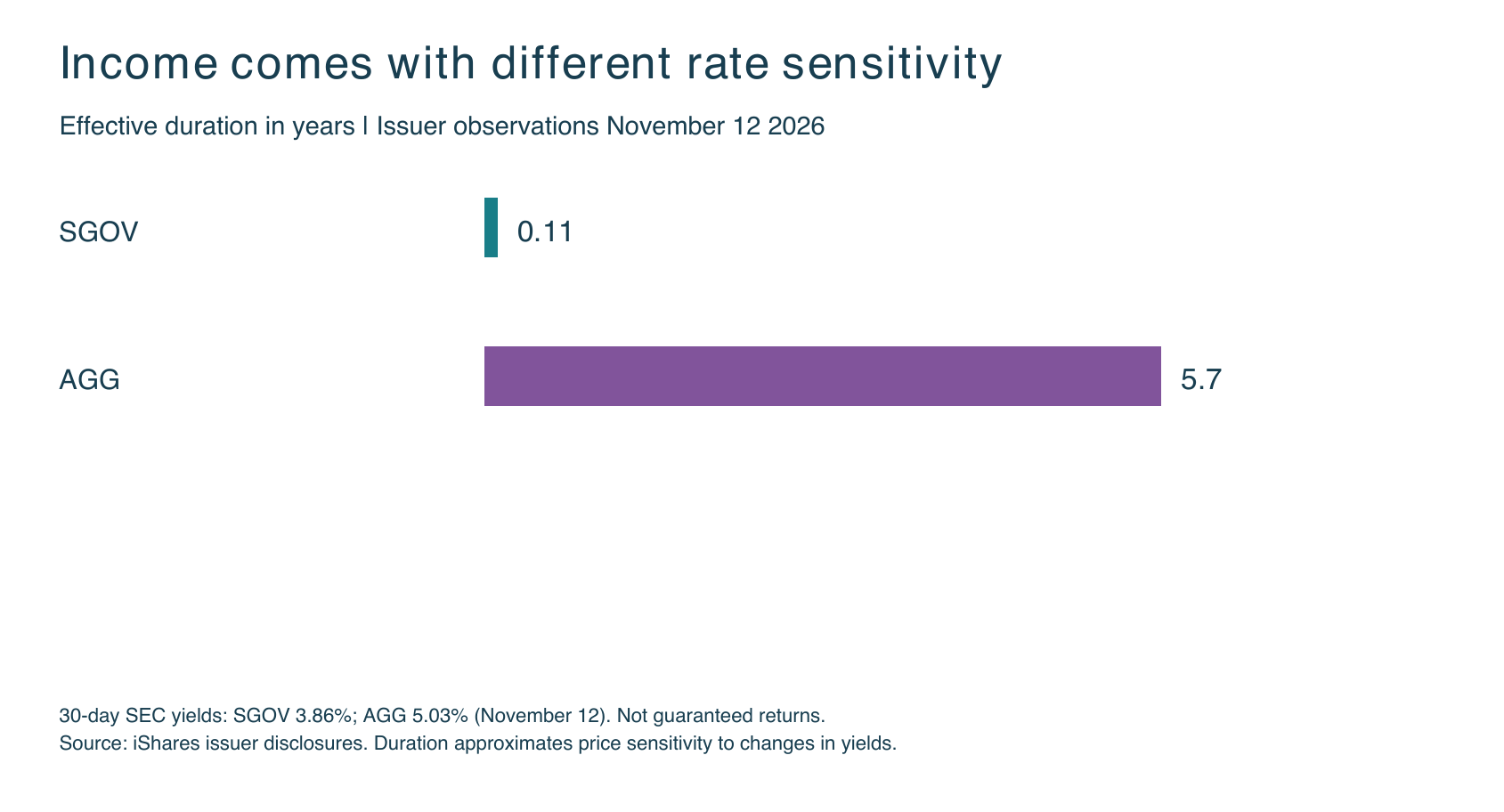
SGOV, the short Treasury fund: standardized 30-day yield of 3.86% on November 12
AGG, the broad bond fund: 5.03% on the same date
These are dated income measures, not guaranteed future returns
TakeawayThe practical question is not which investment pays the most — it is which risk you are being paid to take.
Listening Edition
Duration: why the yields are not interchangeable
Duration comparison — SGOV vs AGG (November 12)
Duration measures approximate sensitivity to interest-rate changes: about 0.11 years for SGOV, 5.70 years for AGG
A one-percentage-point rise in yields would imply roughly a 5.7% price decline for a portfolio with AGG’s duration, before income and other effects — an approximation, not a forecast
TakeawayThe broad bond fund carries much more rate sensitivity — that is the conclusion of the comparison chart.
Listening Edition
Which risk are you paid to take?
If yields rise, existing bond prices generally fall; if yields fall, they generally rise
Short Treasury holdings have less price sensitivity, but their income can fall as maturing bills are replaced; a continuing bond fund does not generally promise to return your original purchase amount on a specific date
Inflation-protected Treasury securities adjust principal with inflation but can still fluctuate in price; dividend stocks can fall and dividends can be reduced
TakeawayMoney for a bill next year and money for retirement in twenty years need not have the same investment.
Listening Edition
The accumulating household
For a household in its thirties or forties, regular contributions and a long horizon can help work through volatility — but the long horizon applies to retirement money, not emergency savings or a near-term home purchase
Review employer matching, plan costs, expensive debt and diversification first
If your paycheck and employer shares depend on technology, additional technology investments concentrate your household risk
TakeawayA reasonable discussion starts with a diversified growth core, an emergency reserve and a contribution rate that can survive a difficult year.
Listening Edition
Approaching retirement: the spending gap
Start with spending minus dependable income: in an illustration, $80,000 of annual spending and $45,000 of dependable income leave $35,000 for the portfolio to supply
Consider whether cash and high-quality bonds maturing when bills come due can reduce forced selling
Holding more cash reduces the need to sell after a loss, but excessive cash weakens long-term purchasing power — retirement may last decades
TakeawayThose are example budgets, not recommendations — the balance depends on income needs, flexibility and resources, not age alone.
Listening Edition
Sequence risk: the order of returns
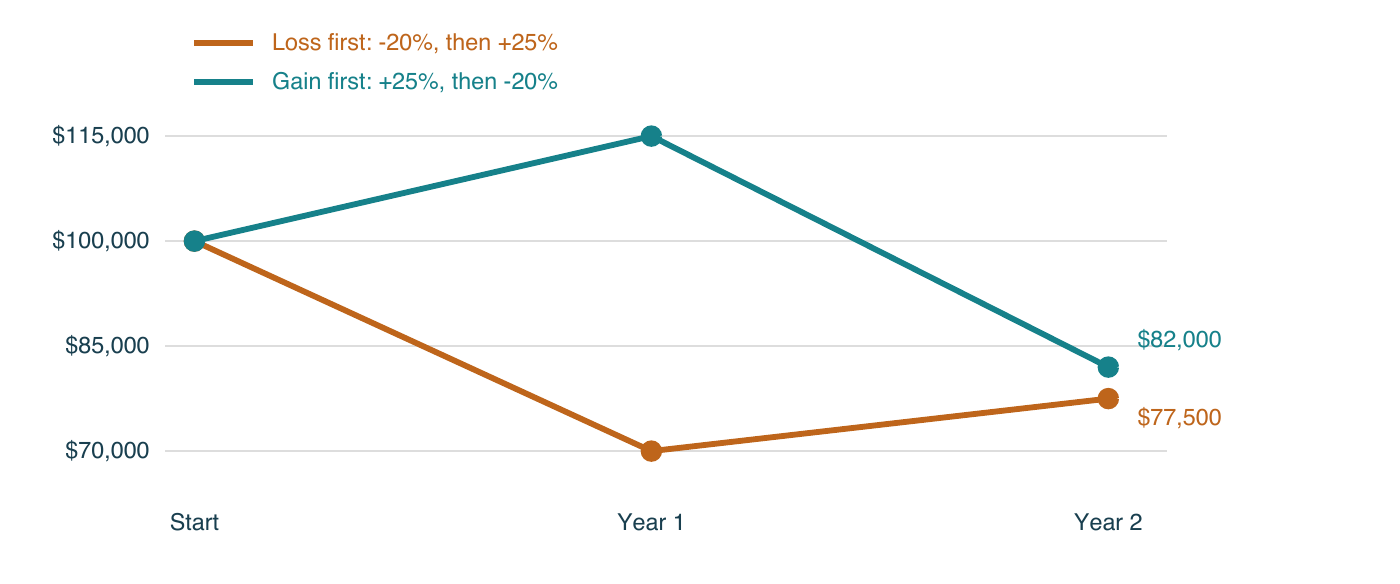
Sequence of returns with withdrawals — hypothetical illustration
Start with $100,000 and withdraw $10,000 at each year end
Loss first (−20%, then +25%): $77,500 left. Gain first (+25%, then −20%): $82,000 left
Without withdrawals, both sequences end at $100,000 — the returns were identical; their order changed the amount left after spending
TakeawayThe example’s withdrawal is deliberately illustrative, not a recommended sustainable rate.
Listening Edition
Use the outlook without turning it into a trade
The six-month view allows continued but uneven adjustment, while the near-term forecast is more cautious — that combination favors checking cash generation and concentration
If financing pressure persists, ask which companies can fund their plans without continually relying on favorable markets
Economic probabilities are not portfolio percentages: a two-to-four-week forecast should not repeatedly overturn a decades-long retirement plan
Before making a change, ask what each holding is for, when the money is needed, which risks overlap and what tax costs a sale would create
TakeawayA forecast is useful when it improves the planning process; it is dangerous when it substitutes for one.
close
What to watch next
Tuesday, November 17: October retail sales and Nvidia’s results
November 20: the port labor deadline and the consumer sentiment update
December 8–9: the Federal Reserve meeting tests the policy path
For the full detail behind today's summary, read the written edition — and on the site you'll also find the reading list, the Market Read, and our editorial promise.
TakeawayThis has been the Market Intelligence Listening Edition for Sunday, November fifteenth, twenty twenty-six. Check back throughout the day for Tactical Scout updates.
For the complete analysis, charts, source citations and curated reading list, visit the Market Intelligence website. The downloadable written report explains the evidence and includes links to the original sources. You can also explore earlier editions to see how the outlook has changed.